
Short answer: A solar battery cable check needs more than a large amperage number. The cable carries a current that must be identified as AC or DC, and the clamp must fit around one accessible conductor without forcing the installation. The Testerac listing identifies the TANS TA813B+ as an AC/DC 1000A clamp meter with a 9999-count display and stated AC/DC current accuracy of ±2.5%+8. It does not publish CAT rating, jaw opening, detailed ranges, low-current resolution, calibration or service life. Use competent electrical procedures and treat each missing value as unknown.
Identify the cable and current before buying
Solar and battery systems can contain more than one measurement point, and the right point depends on the question being asked. Write down whether the planned check concerns DC battery current, AC output or another quantity. The TA813B+ listing supports AC/DC current measurement as a product position, but it does not identify a particular solar inverter, battery system or installation method.
The exact model check is important because the product page excludes the TA813A+ AC-only variant. Do not accept a shortened listing that only says 1000A clamp meter when DC current is part of the job. Keep the model suffix and current type together in the order record.
- Name the cable and the measurement question before selecting the meter.
- Mark the current as AC, DC or both using the system documentation.
- Confirm that one conductor can be accessed without disturbing the installation.
- Stop if the measurement requires opening equipment or a safety category that is not documented.
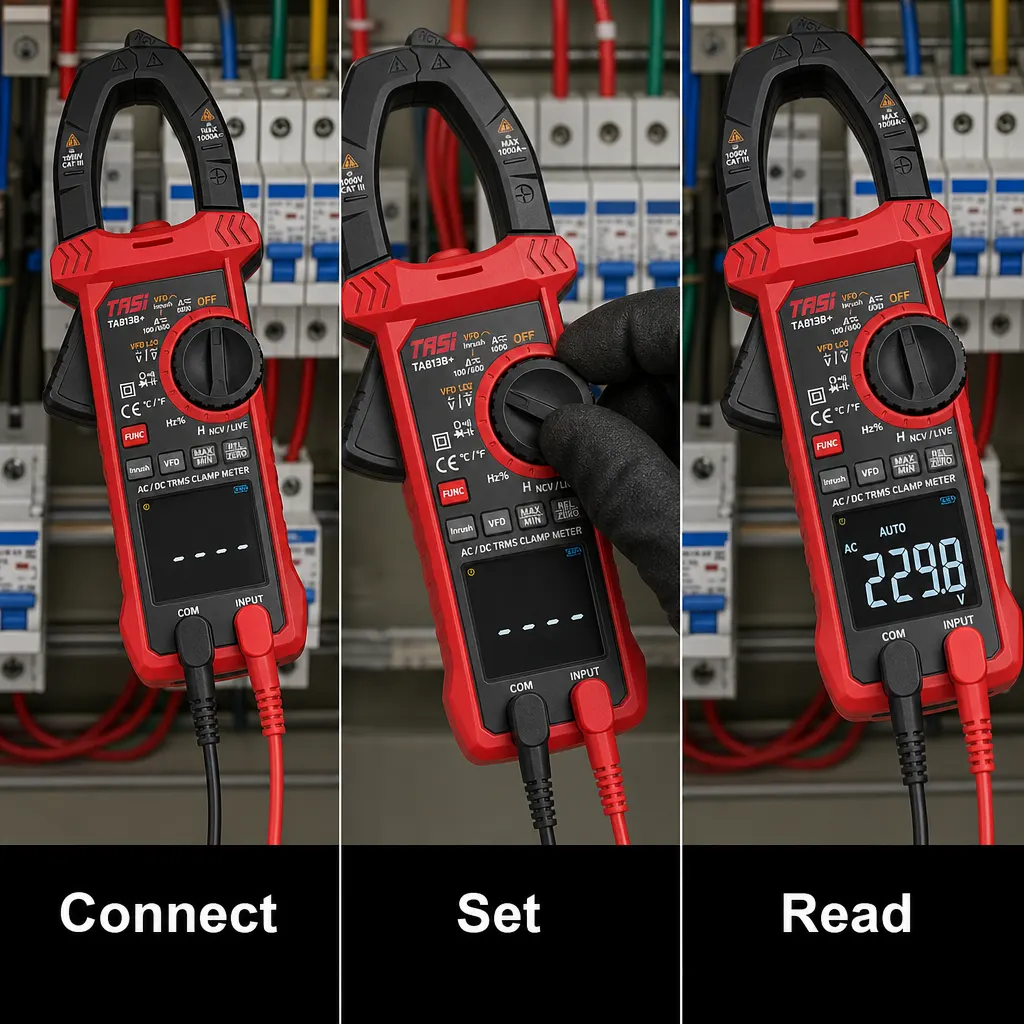
Plan the conductor position honestly
Fluke explains that a clamp reads current around a conductor and that opposite current paths can cancel when enclosed together. For a battery cable, that means planning around one accessible conductor rather than assuming a bundled positive-and-negative run will give a useful result. Do not rearrange wiring merely to create access.
The product page does not give a jaw opening, conductor diameter limit or installation-specific accessory list. Manufacturer does not specify those details. Measure the cable only after confirming the physical fit from manufacturer documentation, and use the site's electrical method for any enclosure or exposed-conductor work.
| Solar-battery question | Required check | TA813B+ page |
|---|---|---|
| Battery current | DC capability | AC/DC stated |
| Cable access | One conductor and jaw fit | Jaw opening not specified |
| Small standby current | Range and resolution | Manufacturer does not specify |
| Electrical safety | Suitable category and procedure | CAT rating not specified |
Use safety guidance for the installation
HSE says people working on electrical equipment or installations must be competent for the task. A solar-battery cable can sit within a wider system with stored energy and exposed conductors, so the product listing cannot replace site isolation, risk assessment or the competent person's method.
GS38 covers electrical test equipment used on low-voltage systems and is a useful authority for selecting suitable equipment and accessories. The TA813B+ page does not state a CAT rating, voltage rating or environmental limit. Do not infer those values from the 1000A name or from another meter.
Set a conservative purchase boundary
Buy only when the exact AC/DC model, the current level and the physical cable access match the documented task. If the job depends on low-current resolution, CAT marking, calibration evidence, jaw opening or a particular solar standard, the product page is incomplete for that decision. Manufacturer does not specify those values.
A useful record includes the cable identity, current type, expected current, required tolerance and every unresolved specification. If the result is safety-critical or the installation is unfamiliar, move the work to a competent electrical professional rather than improvising around a product gap.
Related guides and product details
Treat the TA813B+ as a candidate for a documented AC/DC current check only after the solar-battery cable, access and safety requirements are independently confirmed. Read AC/DC Clamp Meter UK Electrician Guide: Check the TA813B+ for related guidance. Read DC Clamp Meter for a Campervan Battery: UK Buying Checks for related guidance. Review the documented specification on the TANS TA813B+ AC/DC 1000A clamp meter product page before ordering.
Sources and safety context
- Supports the TA813B+ AC/DC product facts and missing specifications. Testerac product page.
- Supports one-conductor positioning and avoiding nearby conductors. Fluke: What is a clamp meter?.
- Supports suitable test-equipment and accessory selection. HSE GS38.
- Supports competence and task-dependent electrical safety. HSE: Work on electrical equipment, machinery or installations.