
Short answer: A clamp meter can observe current around an accessible conductor without deliberately opening the battery circuit, but the method still depends on the exact meter, conductor position and safe working procedure. The Testerac listing identifies the TANS TA813B+ as an AC/DC 1000A clamp meter and states a 9999-count display with AC/DC current accuracy of ±2.5%+8. Fluke explains the need to clamp one conductor, while HSE requires suitable equipment and competent electrical work. The product page does not specify low-current resolution, jaw opening or CAT rating.
Understand what the clamp method answers
The clamp approach answers a narrow question: what current is present in the selected conductor at the selected moment. Fluke describes clamp meters as measuring current around a conductor, which avoids making the meter part of the circuit for that current observation. That does not make the result a complete diagnosis of a leisure battery system.
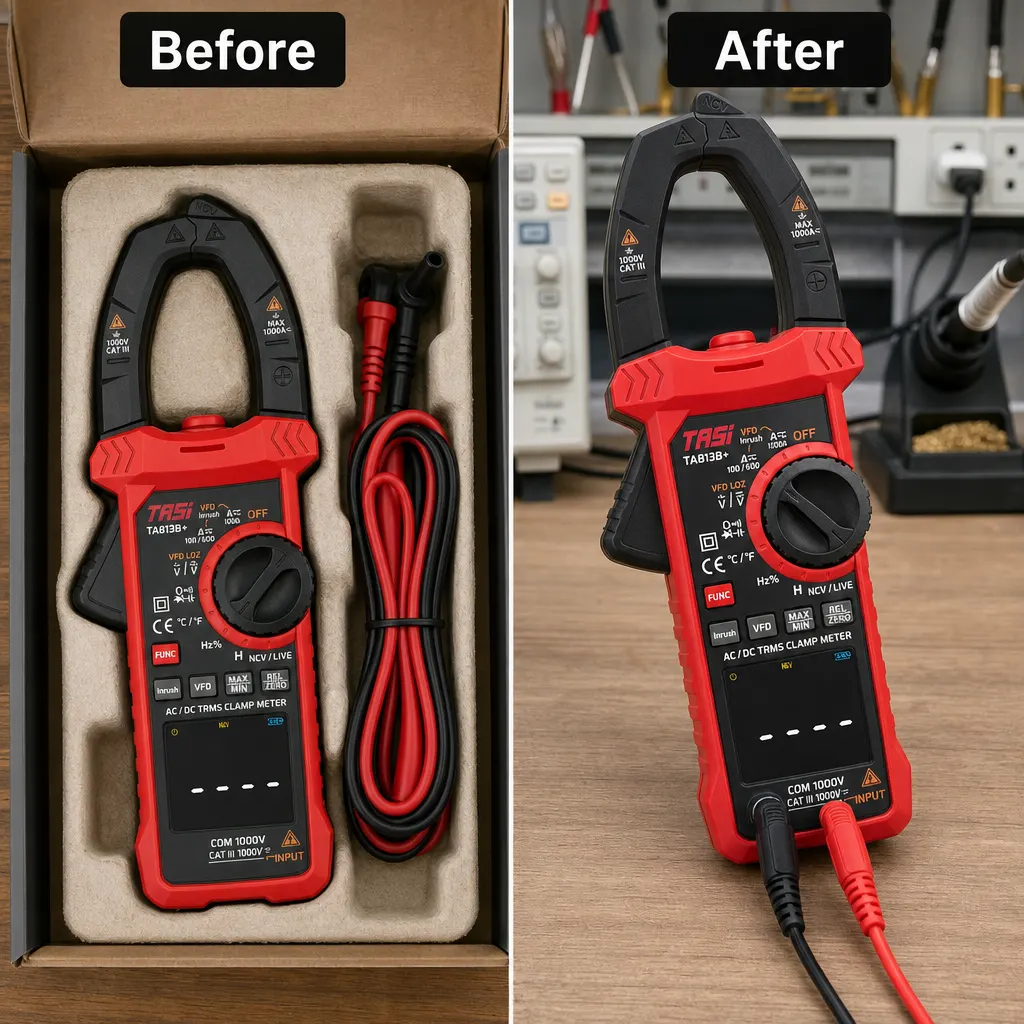
The relevant product choice is the TANS TA813B+ AC/DC model, not the excluded TA813A+ AC-only variant. The page supports the AC/DC product identity, but it does not publish a leisure-battery procedure, low-current resolution or logging capability. Manufacturer does not specify those details.
| Question | What the method can show | What it cannot prove alone |
|---|---|---|
| Is current present? | A reading at one conductor and time | The failed component |
| Does the reading change? | A comparison between system states | Battery health |
| Does the meter fit? | Only after physical inspection | Jaw size, which is not specified |
| Is it safe for the job? | Only with a suitable method | A CAT rating, which is not specified |
Set up around one accessible conductor
Fluke advises placing the clamp around a single conductor and avoiding nearby current-carrying conductors where possible. For a leisure battery, identify the one cable associated with the state you want to observe. Do not clamp around a complete positive-and-negative pair and then treat a small or zero reading as proof that no current exists.
The product page does not state jaw opening, cable-size limits or a zeroing procedure for this model. Manufacturer does not specify these details. Use the model's own instructions when available, keep the jaws closed correctly and do not move battery wiring simply to make the clamp fit.
- Choose the conductor and system state before touching the meter.
- Confirm the exact TA813B+ AC/DC model and select the DC-current function as directed by its instructions.
- Close the jaws around one accessible conductor only.
- Repeat the observation in a second known system state and record both conditions.
- Stop if access, equipment category or user competence is uncertain.
Use HSE guidance for the working boundary
HSE says people working on electrical equipment, machinery or installations must be competent for the task. A leisure battery installation can include chargers, inverters and exposed terminals, so a clamp method is not a permission to work beyond the person's training or the site's controls.
GS38 is intended for users of electrical test equipment on low-voltage systems. Use suitable equipment and accessories, inspect them and follow the maker's instructions. The TA813B+ page does not state CAT rating, voltage rating or environmental limits, so those values are manufacturer does not specify.
Interpret the reading with restraint
A change between two controlled states can be useful evidence that current at the selected conductor changed. It does not identify whether the battery, charger, wiring or load caused the change. The product page's ±2.5%+8 accuracy statement also does not supply the missing low-current resolution or a full uncertainty calculation for a small drain.
If the target is a very small or intermittent current, the TA813B+ page cannot confirm suitability because low-current resolution and logging are manufacturer does not specify. Obtain the missing data or use a tool documented for that task. If the installation is unfamiliar or unsafe to access, stop and use competent help.
Related guides and product details
Use a clamp as a bounded current observation, not a shortcut around safe working practice or missing manufacturer specifications. Read TANS TA813B+ Clamp Meter: Check the AC/DC 1000A Model for related guidance. Read 1000A AC/DC Clamp Meter UK: What the TA813B+ Listing Proves for related guidance. Review the documented specification on the TANS TA813B+ AC/DC 1000A clamp meter product page before ordering.
Sources and safety context
- Supports the TA813B+ AC/DC facts and unpublished limitations. Testerac product page.
- Supports one-conductor clamp measurement and the distinction between a reading and a diagnosis. Fluke: What is a clamp meter?.
- Supports suitable equipment and accessory use. HSE GS38.
- Supports competence requirements. HSE: Work on electrical equipment, machinery or installations.