
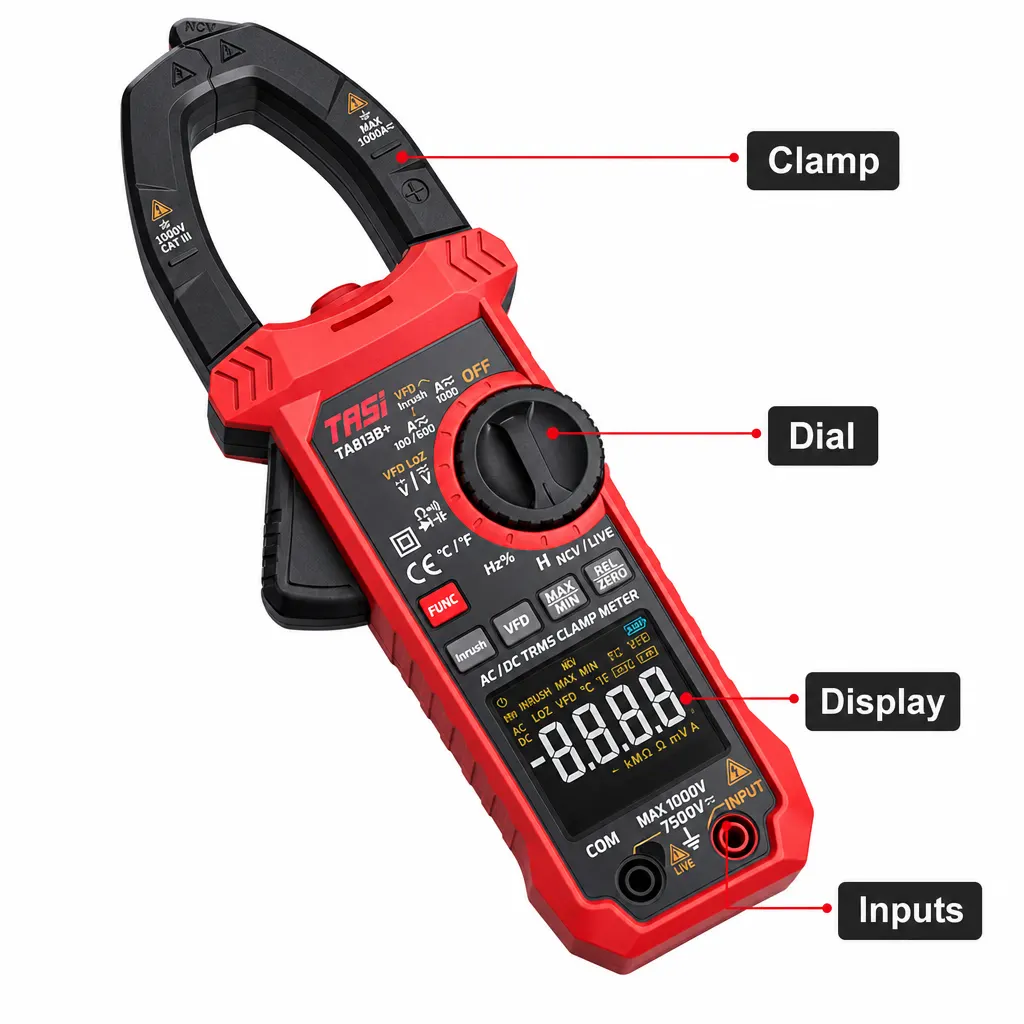
Short answer: A campervan battery current check needs a clamp meter that explicitly covers DC current and can physically reach one accessible conductor. The Testerac product page identifies the TANS TA813B+ as an AC/DC 1000A clamp meter, with a 9999-count display and stated AC/DC current accuracy of ±2.5%+8. It excludes the TA813A+ AC-only variant. The page does not specify low-current resolution, jaw opening, CAT rating, calibration, detailed ranges or service life, so it cannot confirm suitability for a small standby drain or a cramped battery compartment.
Define the campervan measurement
A campervan battery investigation might concern charging current, a switched load or a suspected drain. Write down which state you want to compare and whether the cable carries DC current. The TA813B+ product position is relevant because it is described as AC/DC; the excluded TA813A+ AC-only variant is not an equivalent choice for a DC battery check.
A clamp reading is still a current observation, not a diagnosis of battery health, charger condition or a particular faulty accessory. The product page does not document a logging function, low-current performance or vehicle-specific procedure. Manufacturer does not specify those details.
- Name the battery cable and the system state to be compared.
- Confirm that the job needs DC current and the order shows TA813B+ AC/DC.
- Check that a single conductor can be reached without disturbing terminals or insulation.
- If the target is a small drain, obtain range and resolution information before buying.
Use one conductor and preserve access
Fluke explains that a clamp meter works around a conductor and that current in opposing directions can cancel if both paths are inside the clamp. For a campervan battery cable, plan the check around one accessible conductor. Do not assume that a bundled positive-and-negative cable will produce a meaningful reading.
The TA813B+ listing does not state the jaw opening or cable-size limit. Manufacturer does not specify whether a particular battery lead fits. If access is cramped, do not force the jaws against terminals, covers or damaged insulation merely to obtain a reading.
| Campervan requirement | Documented or open | Action |
|---|---|---|
| DC current | AC/DC stated | Confirm the exact model |
| Single cable access | General clamp principle | Inspect the installation first |
| Small parasitic draw | Resolution not specified | Ask for manufacturer data |
| Safety category | CAT rating not specified | Do not infer it |
Keep battery work inside a safe method
HSE says people working on electrical equipment or installations must be competent for the task. A campervan may combine a battery, charger, inverter and other electrical equipment, so a clamp meter does not remove the need for a suitable method, controlled access and awareness of stored energy.
GS38 guidance is relevant to suitable electrical test equipment on low-voltage systems. Follow the instrument instructions and use accessories appropriate to the work. The product page does not publish CAT, voltage or environmental ratings; manufacturer does not specify them.
Know when the clamp is not enough
A TA813B+ may be worth comparing for an accessible DC-current spot check when its published facts are enough for the job. It is not confirmed for a very small drain, a cramped cable, a formal diagnostic record or a safety-critical task because the needed resolution, jaw opening, calibration and category evidence are absent.
If the measurement is unstable or unexpectedly small, do not turn a single display value into a conclusion about the battery or a component. Recheck the conductor and method, then obtain better-documented equipment or competent help. The product page does not claim diagnostic certainty.
Related guides and product details
For a campervan battery, choose the TA813B+ only after confirming DC capability, safe one-conductor access and the missing low-current information. Read How to Measure Leisure Battery Current Without Disconnecting for related guidance. Read TANS TA813B+ Clamp Meter: Check the AC/DC 1000A Model for related guidance. Review the documented specification on the TANS TA813B+ AC/DC 1000A clamp meter product page before ordering.
Sources and safety context
- Supports the TA813B+ facts and the unknown specification list. Testerac product page.
- Supports single-conductor clamp positioning. Fluke: What is a clamp meter?.
- Supports suitable equipment and accessory checks. HSE GS38.
- Supports competent-person expectations for electrical work. HSE: Introduction to electrical safety.