
Short answer: A 1000A AC/DC clamp meter is only a sensible purchase when its exact model, current type and published limits match the job. The Testerac listing identifies the TANS TA813B+ as an AC/DC 1000A clamp meter and states a 9999-count display with AC/DC current accuracy of ±2.5%+8. Those facts do not establish a CAT rating, jaw opening, low-current resolution, calibration status or suitability for a particular installation. Check the conductor, expected current and working procedure first. Where the product page is silent, treat the detail as unknown and ask the manufacturer or choose a better-documented instrument.
Start with the exact model and current type
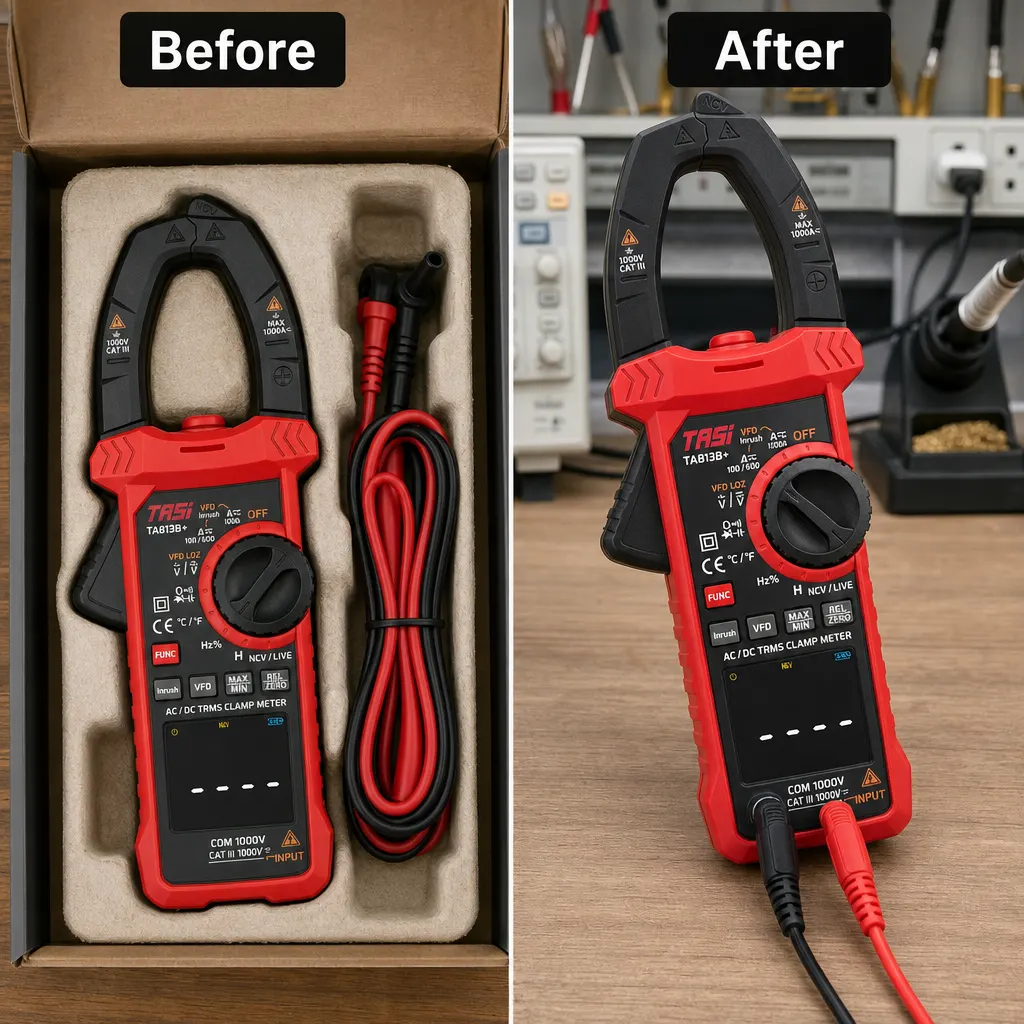
The product page names the instrument as the TANS TA813B+ AC/DC 1000A clamp meter. That identity matters more than the shared 1000A wording because the same offer context excludes the TA813A+ AC-only variant. If the job includes DC current, an AC-only model is not an equivalent substitute. Record the full model suffix and the required current type on the purchase request.
A clamp meter is intended for current measurement around a conductor. Fluke's guidance says to place the clamp around one conductor and avoid nearby current-carrying conductors where possible. That is a general measurement principle, not proof that this particular product fits a cable or installation. The product page does not specify jaw opening or installation suitability.
| Check before ordering | Published position | Decision |
|---|---|---|
| Model | TANS TA813B+ | Reject a TA813A+ AC-only substitute |
| Current type | AC/DC stated | Match the planned circuit |
| Headline current | 1000A designation | Compare with the expected current |
| Safety category | Manufacturer does not specify | Do not infer a CAT rating |
Read the published numbers without overclaiming
The listing states a 9999-count display and AC/DC current accuracy of ±2.5%+8. Keep the complete accuracy expression when comparing the instrument with a procedure; shortening it to ±2.5% loses part of the published wording. The page does not provide enough range, resolution or test-condition detail to turn that statement into a job-specific uncertainty calculation.
A 1000A headline does not tell you the smallest useful current, the resolution at a particular range or the effect of conductor position. Fluke's technical material treats range, resolution and accuracy as separate specification points. For the TA813B+, low-current resolution, detailed ranges and calibration status are manufacturer does not specify.
Put electrical safety before the buying shortcut
HSE says people working on electrical equipment, machinery or installations must be competent for the task, with the required level depending on complexity. A clamp meter listing does not make an untrained person competent and does not replace a safe system of work. If the planned measurement involves exposed live parts or opening equipment, follow the employer's risk controls and use competent personnel.
HSE GS38 is guidance for people using electrical test equipment on low-voltage systems. Use equipment and accessories suitable for the work, inspect them and follow the instrument instructions. The product page does not state a CAT rating, voltage rating, insulation category or environmental rating, so manufacturer does not specify those details and they must not be guessed.
Decide whether the evidence is enough
Proceed only when the TA813B+ identity, AC/DC requirement and expected current are aligned, and the published information is sufficient for the procedure. If a decision depends on jaw size, a low-current reading, CAT marking, calibration evidence or a particular environment, this listing does not confirm it. Ask for manufacturer documentation or select an instrument that publishes the needed detail.
The restrained buying conclusion is simple: the product page supports a TA813B+ AC/DC 1000A comparison, not a universal safety or performance claim. Keep the product page beside the job sheet, preserve the full accuracy wording and record every unresolved specification instead of filling the gap from another model.
- Write the exact model as TANS TA813B+ and mark whether the job needs AC, DC or both.
- Compare the expected current with the 1000A designation, then identify whether low-current resolution is required.
- Check conductor access, required jaw opening and any safety-category or calibration requirement.
- Stop and obtain documentation when a required value is manufacturer does not specify.
Related guides and product details
Use the TA813B+ listing as a narrow product comparison, not as a substitute for a task-specific electrical risk assessment or missing manufacturer data. Read 1000A Clamp Meter for Electricians: TA813B+ Checks Before Buying for related guidance. Read AC/DC Clamp Meter 1000A UK: How to Check the TA813B+ for related guidance. Review the documented specification on the TANS TA813B+ AC/DC 1000A clamp meter product page before ordering.
Sources and safety context
- Supports the TA813B+ identity, AC/DC 1000A designation, 9999-count display, ±2.5%+8 wording and excluded TA813A+ variant. Testerac product page.
- Supports the general point that current is measured with the clamp around a single conductor and nearby conductors can affect readings. Fluke: What is a clamp meter?.
- Supports the need for suitable electrical test equipment and accessories on low-voltage systems. HSE GS38: Electrical test equipment for use on low voltage electrical systems.
- Supports the competence requirement for electrical work. HSE: Work on electrical equipment, machinery or installations.